
From the Dentist Who Developed PerioPerio
Thank you for visiting the PerioPerio website. I am Motegi, the person in charge of this project.
I would like to share the background behind the development of this web application.
As periodontitis progresses, dentists are often faced with the necessity of extracting teeth.
When periodontitis becomes advanced, when considering a transition to implant treatment, or when a patient develops dementia and can no longer maintain proper dental self-care, dentists must make difficult decisions about whether to preserve or extract a tooth. Even among teeth with the same scaling grade, some may be preserved with regenerative therapy, while others may need to be extracted to make space for a bridge.
Periodontal indices serve as a “measuring stick” for assessing disease progression at various treatment stages, ultimately falling under the dentist’s professional judgment. However, their role extends beyond this; these indices also play a crucial part in helping patients provide informed consent regarding their treatment. I have consistently felt the need for a clear, rational method to evaluate periodontal disease progression that satisfies both the practitioner and the patient.
As it has become understood that periodontal disease can trigger or worsen systemic diseases, opportunities for medical collaboration have increased. When physicians from other fields, such as surgery or internal medicine, ask for an opinion on a patient’s periodontal status, many dentists may feel uncertain about how to respond.
The diagnosis and prognosis of periodontal disease are becoming increasingly important not just within dentistry, but across all of the medical field. However, unlike indicators for conditions like blood sugar or γ-GDP levels, which provide practical measures of a disease’s current state, the field of periodontology lacks such practical benchmarks.
Even when telling patients, “Your periodontal disease is quite advanced,” the response might be a simple “Oh, really?” This often makes it difficult to smoothly obtain informed consent from patients or proceed with appropriate treatment.
However, if we could present clear, concrete numerical values like blood glucose, γ-GDP, or creatinine, patients would likely understand better. Seeing numbers allows them to grasp the severity of their condition. Furthermore, numerical values make it easier to communicate changes over time, such as improvements or worsening.
The lack of a yardstick to measure the progression of periodontal disease stems from the difficulty in creating such an indicator. While it cannot be generalized by race, there are broad differences in root length between Asian and European populations. For example, the root length of Asians, including Japanese, is shorter than that of Europeans, with the difference of up to 2mm depending on the tooth type (“Relationship between staging and grading of periodontitis(AAP・EFP2018) and The classification of periodontitis(JDA2007)speculated through CAL“).
Even within a single individual, root length and periodontal ligament area vary by tooth type. We reported on these tooth-type differences in a 2024 academic paper (Stages and Grades of the 2018 AAP/EFP Classification of Periodontitis Vary by the Tooth Type: A 5-year Observational Study. Motegi et al., 2024).
Currently, the new periodontitis classification is applied for simplified classification. However, since this classification was developed in Western countries, applying it directly to Asians can lead to differences in the assigned classification, as we reported in a 2022 academic paper.
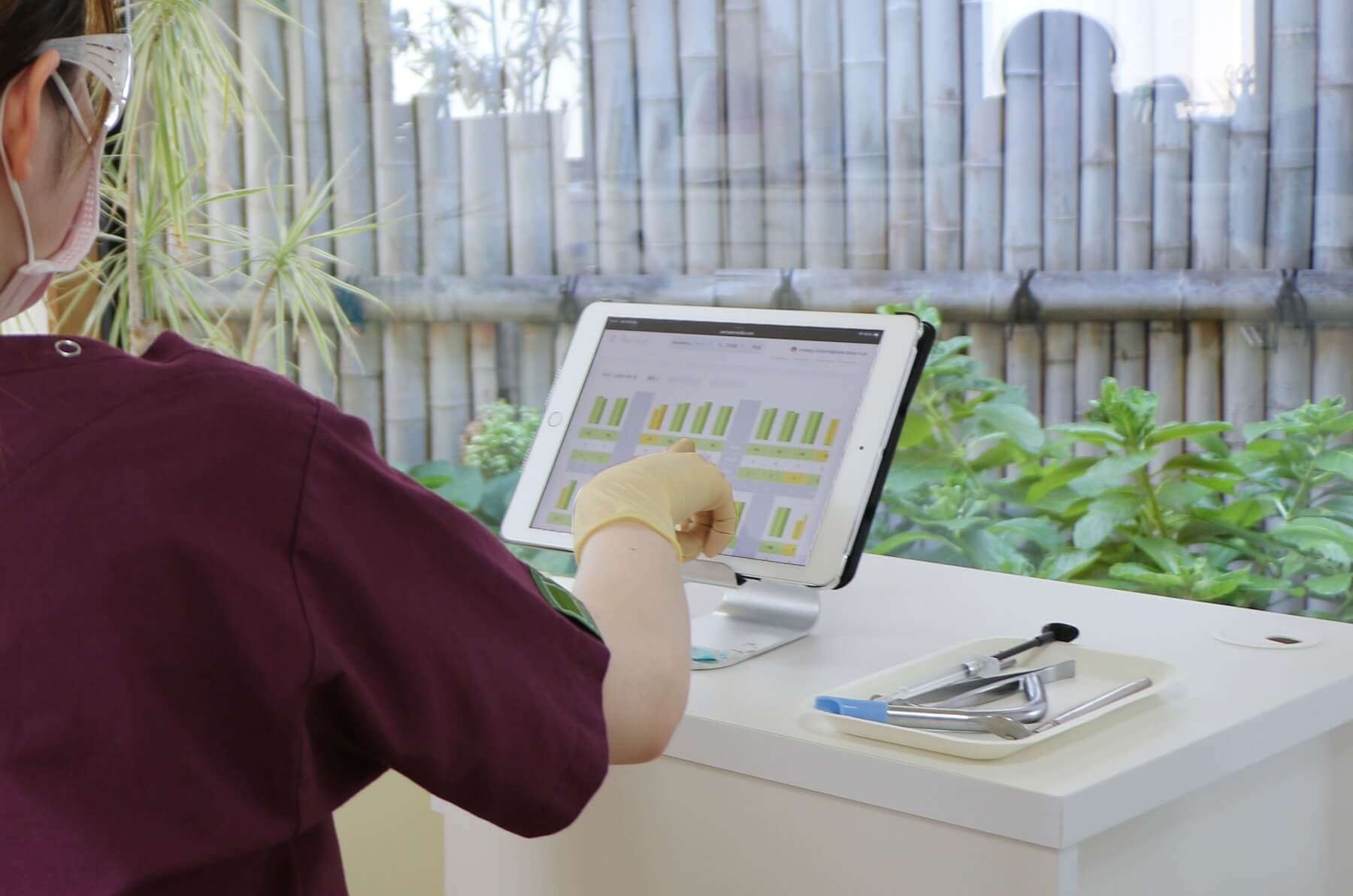
PerioPerio accounts for this difference. By incorporating criteria for evaluating periodontal disease progression suitable for Asians, it enables more accurate diagnosis of disease progression and prognosis. PerioPerio, a periodontitis assessment app based on secondary occlusal trauma derived from the relationship between occlusal force and periodontal ligament cross-section, has been launched in Japan and worldwide. It serves as both a practical gauge for periodontitis progression and an easy-to-understand app for patients.
We are committed to continuous improvement, striving daily to develop more precise evaluation methods. We sincerely appreciate your continued support.
Dentist, Yoshio Motegi